Showing posts with label ART/LIT. Show all posts

4/14/11

3 artists

There's plenty that distinguishes Vik Muniz, JR, and Ai Weiwei from one another, but what connects them in my mind is their ability to make large-scale, politically interesting art that retains a highly personal quality. Each has an activist streak and a desire to effect change outside galleries and museums.

Waste Land is a documentary about Vik Muniz's collaboration with several people who scavenge recyclable material in Jardim Gramacho, the world's largest trash dump located outside Rio de Janeiro.


Muniz and his crew work with the recyclers/models to create large mosaics which are photographed and auctioned off, the proceeds benefiting each model or an organization connected to that model. The story of how folks earn a living at Jardim Gramacho is, on its own, worthy of your attention, but add to that the impact of Muniz's intervention in the their lives and the film becomes extraordinary.


TED Prize winner, JR explains how his 'sidewalk galleries' evolved into a wish to change the world in the clip blow. In 2009 he told Beaux Arts Magazine, "I want to try to create images of hot spots such as the Middle East or Brazil that offer different points of view from the ones we see in the worldwide media which are often caricatures." The result of JR's TED wish is the Inside Out Project. 


Ai Weiwei is an artist and activist from China whose output includes sculpture, installations, photography, architecture, not to mention his prodigious blogging and tweeting. Frontline's short documentary, Who's Afraid of Ai Weiwei?, provides an excellent overview of his art and activism, particularly how he organized an investigation into poorly constructed school buildings following the Sichuan earthquake. (Why PBS doesn't enable users to embed clips baffles and frustrates me.)

A week ago, Weiwei was detained by authorities in Beijing as he was attempting to board a flight to Hong Kong; as of today, his whereabouts are unknown. Before his arrest, Weiwei described his work and the challenges he faces as an artist in China in this clip.

6/28/09

Fukú Americanus

When Sean San José told Junot Diaz that he wanted to adapt Diaz's novel The Brief and Wondrous Life of Oscar Wao for the stage, Diaz replied, "Good fucking luck, bro." Given the two had collaborated before, his comment seems more like a blessing than skeptism. Perhaps Diaz, who spent 11 years writing the novel, was hinting at the challenge ahead.

Fukú Americanus, directed by San José and Marc Bamuthi Joséph at Intersection for the Arts, centers on the lives of Dominican immigrants growing up in Northern New Jersy during the 1980s. The play retains the novel's mix of sci-fi, hip-hop, and historical references, but the book's violence is toned down on stage. The cast is strong, equally skilled with comic and poignant moments. The play's short scenes look more choreographed than blocked, often flowing together with transitions provided by a narrator, Fukú, a character who doesn't appear in the novel. Think: a younger, funkier, vagabond-version of Our Town's Stage Manager.

The concept of Fukú is defined in Wao as "the Curse and the Doom of the New World." The character on stage is more inviting / less menacing than that. Early in the play he delivers what might have been my favorite line of the evening: "There may be some of this you don't understand, but that's part of it."

Someone's story doesn't need to be 100% comprehensible for it to be worth knowing. I doubt any audience member walked in with perfect knowledge of the Diaz lexicon--it's that diverse. As someone roughly the same age as Diaz, I felt clued into the pop culture references but the dialogue in Spanish simply washed over me. Still, the play's physical and emotional momentum carried me along, and that feeling (being forced to look for meaning in context, tone, body language, facial expressions...) may have brought me closer to Oscar's experience--being a stranger in a strange land. That's what I think Fukú meant by "that's part of it."

For locals: the show has been selling out, and the run has been extended until July 12.

* * *

The Cast: Carlos Aguire (Yunior), Maria Candelaria (Moms), Vanessa Cota (Lola), Biko Eise-Martin (Fukú), Anna Maria Luera (La Inca), and Brian Rivera (Oscar).
* * *
For more: read SF Chronicle's preview, which included Diaz's "good luck" line.
* * *
From the SF Guardian review.
Act one of Fukú Americanus, Campo Santo's adaptation of Pulitzer prize-winning The Brief Wondrous Life of Oscar Wao, explodes across the stage like a Caribbean hurricane.... The second act...is less cohesive...and unlike the book, does not resolve itself in Oscar's ultimate tragedy, which is a little like ending Hamlet before the duel. Denied both his tragic end, and his triumphal devirginization, Oscar's role in this adaptation is less that of anti-hero, than one of hapless foil in the larger sweep of fukú's pitiless influence. (N. Gluckstern)
* * *
From the NYT's review of Wao.
Junot Díaz’s Brief Wondrous Life of Oscar Wao is a wondrous, not-so-brief first novel that is so original it can only be described as Mario Vargas Llosa meets “Star Trek” meets David Foster Wallace meets Kanye West. M. Kakutani's full review.
* * *
Diaz discusses the character of Oscar at the Sydney Writer’s Festival


The Colbert ReportMon - Thurs 11:30pm / 10:30c
Junot Diaz
http://www.colbertnation.com/
Colbert Report Full EpisodesPolitical HumorTasers

p.s. to the Colbert clip: The Day of the Triffids is a post-apocalyptic novel written in 1951 by the English science fiction author John Wyndham. Tiffids are a highly venomous (fictional) plant species and the titular antagonists of Wyndham's novel.

6/2/09

A note from a native son

I love America more than any other country in the world, and, exactly for this reason, I insist on the right to criticize her perpetually. I think all theories are suspect, that the finest principles may have to be modified, or may even be pulverized by the demands of life, and that one must find, therefore, one's own moral center and move through the world hoping that this center will guide one aright.

-James Baldwin, Autobiographic Notes, Notes of a Native Son

4/30/09

Yield To Total Elation

Achilles G. Rizzoli (1896-1981) was a San Francisco Bay Area native, a professional draftsman, and visionary artist.

By all accounts, Achilles Rizzoli was a devoted son and a competent employee. A work colleague described him as friendly but not sociable. He appears to have had no close friends and was a lifelong celibate who may have suffered from mental illness. The earliest article I found about him was written in 1992 by John MacGregor, who seems to have had access to his journals.
[Rizzoli] speaks again and again of his "confusion, inability to mobilize the mechanics of recording impressions automatically, for the most part dwelling in a sphere of shifting sand-like maze of colour, paste, light and sound". Such elaborate documentation of hallucinatory experience, in both written and graphic form, all carefully dated, is uniquie in the phenomenology of schizophrenia. ("A.G. Rizzoli: The Architecture of Hallucination", Raw Vision #6)
Every other source I came across points to A. G. Rizzoli: Architect of Magnificent Visions by Hernandez, Beardsley and Cardinal (1997). Many of the biographical details referenced below were gleaned from this book.

Only a few neighbors and colleagues took notice of his art during his lifetime. Nine years after his death, a sample of his work made its way to Bonnie Grossman, founder of The Ames Gallery. Investigating further, she uncovered over 40-years-worth of Rizzoli creations in his great-nephew's attic. In 1997 the San Diego Museum of Art launched a two-year traveling exhibition of his drawings that was accompanied by Architect of Magnificent Visions, the definitive study of the artist and his work. A documentary film, Yield to Total Elation: The Life and Art of Achilles Rizzoli, was released in 2000.

Symbolic representations, or "transfigurations" as he called them, made up the bulk of his visual work between 1935 and 1944. His depictions of people and events as mansions, towers, and cathedrals mix a variety of architectural styles including Beaux-Arts, Art Deco, Art Nouveau, Renaissance, and Romanesque. The drawings are embellished with religious iconography and affectionate sentiments about the subjects, sometimes written in verse. On the first Sunday of each August between 1935 and 1940, Rizzoli hosted the A.T.E. (Achilles Tectonic Exhibit) at his home in the Bernal Heights neighborhood of San Francisco. Several of the pictures below commemorate the visits of attendees. Also featured below is the one of the plot plans for Y.T.T.E. (Yield To Total Elation), an invented world's fair-like expo.

hi mom

Mother Symbolicly Represented (1935)


Mrs. Geo. Powleson Symbolically Portrayed (1935)


1st prize

"In appreciation of the kindly interest they have shown in their visit to the A.T.E. during its first anniversary day, August 2, 1936."


planned for chestnut and polk in SF

The Primal Glimpse at Forty (1936)
"That you too may see something you've not seen before"


Alfredo Capobianco and Family Symbolically Sketched (1937)


The YTTE Plot Plan (1938)


a pun?

Shirley was a 6-year old kid from the neighborhood. (1939)


Holt

"A Scholar and a Gentleman" (1939)


Zach

"The Palace God is Building for Abraham N. Zachariah" (1939)


Assorted Images

* * *

Rizzoli focused his creative creative energy on writing prior to 1935. His self-published book, The Colonnade (1933) was billed as "Versified Fiction Romancing Total Love in Vivid Terms of Highly Entertaining Monumental Mediums." The effort generated little or no interest; 3,000 seal copies of book were found in his home after his death. His final creative undertaking was AMTE’s Celestial Extravaganza (AMTE = Architecture Made To Entertain), a journal of his visions, recorded in prose, poetry, and illustrations (1958-1977).

I found other good accounts of his life in this blog this blog, and The Ames Gallery site. Newspapers that critiqued the '97/'98 exhibition included the SF Chronicle, SF Examiner, and the NY Times. Note to locals: the San Francisco Public Library offers archives of Raw Vision magazine, along with Magnificent Visions, and the documentary film Yield to Total Elation.

* * *
Related Images

Rizzoli graduated from poly-technical school in 1915

Tower of Jewels, Panama-Pacific International Exposition, San Francisco, 1915


notice the white figures near the entrance?
Grace Cathedral, Nob Hill, San Francisco, built between 1928 and 1964


Coit Tower, Telegraph Hill, San Francsico, built 1933


Golden Gate International Exhibition, Treasure Island, San Francisco Bay, 1939


Rizzoli's former home, Alabama Street in Bernal Heights, San Francisco, 2009

4/6/09

Anticipating something wild

Is it too early to be excited by the film version of Where the Wild Things Are? The adaptation of the book written and illustrated by Maurice Sendak is directed by Spike Jonze and due out October 16, 2009. I've collected a few choice links below for those who want to geek-out with me.

Some are wincing at the prospect of a beloved book being warped on screen. I think any film that can pack the same speaks-to-you/stays-with-you punch as the book would be a feat. Maybe the film will fall short, or maybe it will stick the landing. Either way, I'm looking forward to it because I expect to see something daring, passionate and personal.


From an interview with Spike Jonze:
One of the things I was worried about is that the book is just so beloved to so many people. And as I started to have ideas for it I was worried that I was just making what it means to me, and what the book triggers in me from when I was a kid. And I’d be worried that other people were gonna be disappointed, because it’s like adapting a poem. It can mean so much to so many different people.

And Maurice was very insistent that that’s all I had to do... just make what it was to me, just to make something personal and make something that takes kids seriously and doesn’t pander to them. He told me that when his book came out, it was considered dangerous. It was panned by critics and child psychologists and librarians, because it wasn’t how kids were talked to. And it took like only two years after the book was out that kids started finding it in the libraries, and basically kids discovered it and made it what it is. And now it’s 40 years later and it’s a classic. So he said you just have to make something according to your own instinct.


In his acceptance speech for the Caldecott Medal, awarded for American picture books for children, Sendak said:
What is too often overlooked is the fact that from their earliest years children live on familiar terms with disrupting emotions...fear and anxiety are an intrinsic part of their everyday lives... they continually cope with frustration as best they can. And it is through fantasy that children achieve catharsis. It is the best means they have for taming Wild Things.

It is my involvement with this inescapable fact of childhood--the awful vulnerability of children and their struggle to make themselves King of all Wild Things--that gives my work whatever truth and passion it may have.
The remarks above were found in this article about Wild Things and child psychology.

If you wish to watch Sendak speak at length about his life and work, check out the interview he did with this Bill Moyers. It covers the Sendak's childhood, his fatalism, his faith in art, and the inspiration for Wild Things. Thanks to Dana Stevens from the Slate Culture Gabfest for sharing this link via facebook.

3/2/09

8-bit porn


I understand the appeal of the 8-bit aesthetic. There was a time when a digital representations of anything, no matter how simply rendered, seemed cool and clever. For those of us who were young during the late 1970s and early 1980s, 8-bit art can still provoke nostalgic, heart-warming reactions.

JeanYves Lemoigne has subverted that feeling (or taken it to a new level, depending on your sensabilities) with these sculptures / photographs. Trying to remain open minded, I'm left wondering: Must we peel the panties off the feeling of being 9 years old?


10/12/08

When will you be angelic?

Below are two recordings of Allen Ginsberg reading his poem "America." The first, recorded in 1956, features an early draft of the text and takes place in front of live audience. Commenting on his performance, The Poetry Archive writes, "Ginsberg's irrepressible humour delights his audience even as his poem enumerates reasons to despair with contemporary American culture."


Ginsberg trimmed the poem considerably between that reading and publication. A recording (below) of the final text is more somber and has greater resonance. Each line strikes with the deftness of a sharply thrown dart. Even a wild passage such as "My national resources consist of two joints of marijuana, millions of genitals, an unpublishable private literature that goes 1400 m.p.h., and twenty-five-thousand mental institutions" is delivered with precision.

Both versions include what I think is one of most touching closing lines in American poetry. The idea of the outcast who refuses to give up gets me every time.

4/5/08

Anna Deavere Smith

My last post touched on government’s role in addressing racial inequity, but since so much of political speech is intended to persuade rather than inform, it's worth seeking out non-political perspectives.

Anna Deavere Smith is an actress, playwright, and professor. She may be best known for her recurring roles on TV shows like the West Wing, but it's her work in the theater that makes her a national treasure. Two of her best-known plays deal with racially-charged events. Fires in the Mirror: Crown Heights, Brooklyn, and Other Identities centers on a 3-day riot that followed the accidental death of an African-American child who was struck by a rabbi's motorcade, and Twilight: Los Angeles 1992 explores the riots that followed first trail of white and Hispanic police officers accused of assaulting motorist Rodney King. 

Smith's technique gives her work a documentary-like quality. She records interviews with hundreds of individuals connected to an event, creates a script from the transcripts of those interviews, and then performs the remarks of every character herself. The viewer is left with an experience that feels intimate and near-comprehensive. 

In this 2006 interview on PBS, she encourages people "to step outside their safehouses of identity," a metaphor for collaborating with those from different backgrounds, and meet at the "crossroads of ambiguity." She goes on to acknowledge the inherit risks of such activity. For those not ready to make that leap, I'll suggest Smith's work can serve as an interim step. Watching one person masterfully portray multiple characters, some with diametrically opposed views of the same event, gives you the sense that understanding 'the other' is not only possible but a goal worth pursuing.

Highlights from the 2006 interview include her depiction of a real estate agent describing the scene at the Beverly Hills Hotel during the 1992 L.A. Riot and her version of Cornel West explaining the difference between optimism and hope.

The video embedded below features four additional pieces, all worth watching.

A Sampler

Portrayed in this clip: Studs Turkle, Reporter @ 1:00; Paulette Jenkins, Inmate @ 6:00; Young Soon Han, Former Store Owner @ 12:20; Brent Williams, Bull Rider @ 18:40.
* * *
In the mood for data instead of drama? Gallop regularly conducts surveys related to race and race relations in the U.S.

1/31/08

New dictionaries

Xiaolu Guo's novel, A Concise Chinese-English Dictionary for Lovers, tells the story of "Z", a 23-year-old woman who travels from rural China to London to study English.

Definitions open each diary-like chapter.

Definitions are succinct, clear, tidy; real life: not so much. Isolated and lonely in London, she looks beyond her pocket dictionary for meaning and enters a relationship with a man 20 years her senior. Months pass, Z's English improves, and her sensibilities expand with a multitude of new experiences ranging from attending a sex show to participating in her first family Christmas. While her communication skills develop nicely, fundamental concepts, such as love, still require some reconciling.

Guo handles the personal, cultural and political aspects of this story deftly and with humor. She instills Z with a sensitivity, cleverness and poetic streak that makes the book highly readable. This is Xiaolu Guo's first novel written in English; she’s also a film-maker. You can hear her speak about Concise in this NPR interview.

* * *

Imaginationally, an illustrated dictionary, details the daily experiences of Creativity Explored artist, Michael Bernard Loggins. Maybe your life is simple enough to fit within the confines of Webster's, but his is not. Loggins is a verbal mix-master who knows what's what.

o man

Imginationally is the follow-up to Fears of Your Life, a handwritten book in which Loggins chronicles his fears both great and small. Fears of Your Life was featured on This American Life and excerpted in Harper's.

1/13/08

Twigs, berries, gods and goddesses

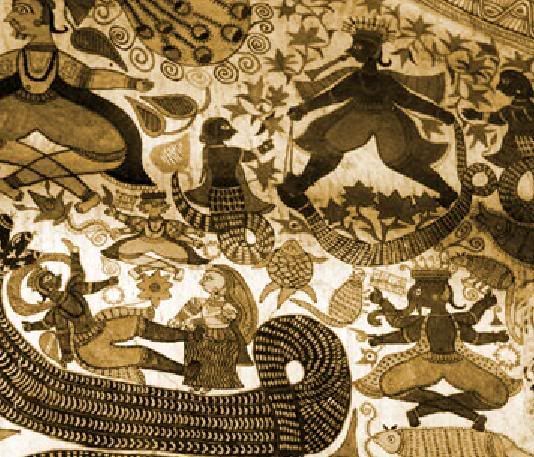
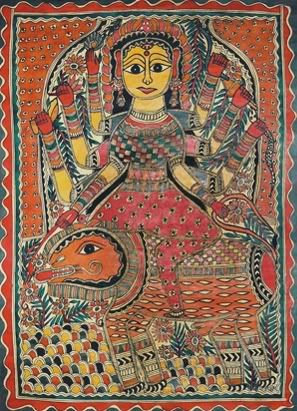
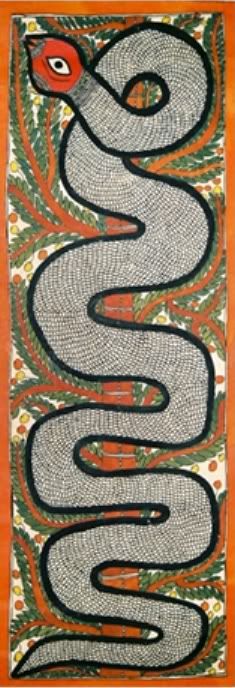
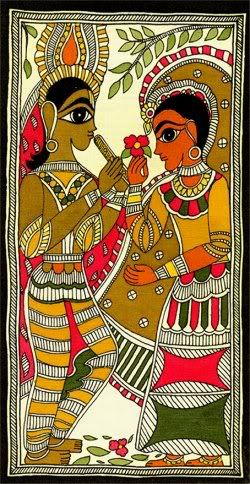
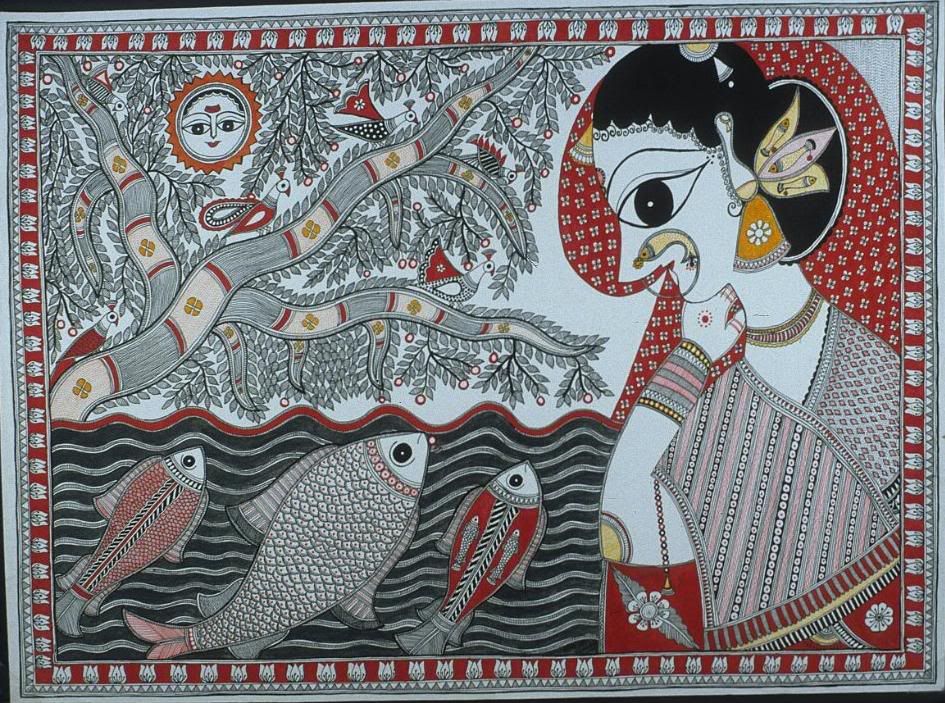
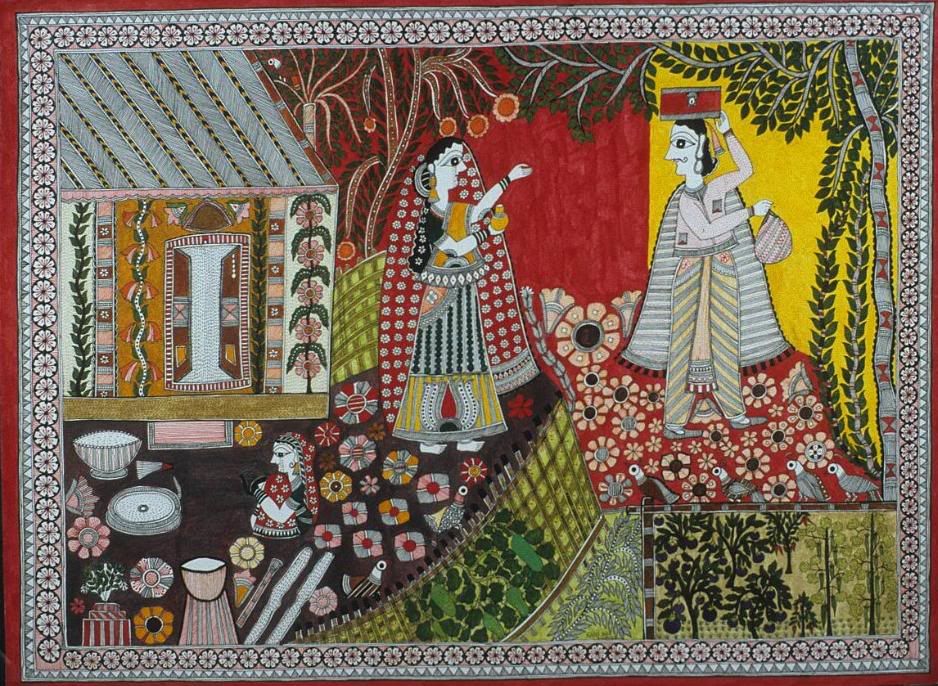
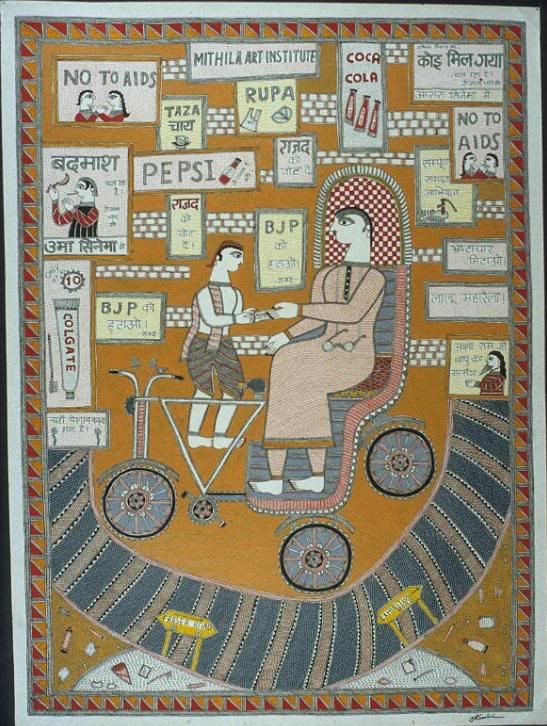
I was introduced to Mithila painting at a talk hosted by the World Affairs Council in SF.

Women living in Madhubani, India (map) have been decorating their homes during communal rituals for hundreds of years using twigs for brushes and making pigment from clay, berries, and dung. The oldest woman will start a picture by placing a red dot in the center of a wall. The most skilled artists outlines the principle figures, and younger girls fill-in the details. The Ethnic Arts Foundation writes, "These paintings, inside their homes, on the internal and external walls of their compounds, and on the ground inside or around their homes, create sacred, protective, and auspicious spaces for their families and their rituals."

Financially poor, these folks are heavily dependent on agriculture, leaving them vulnerable to droughts and floods. During an extreme drought in the 1960s, outsiders introduced paper to the community and encouraged local artists to expand their work to that medium, making their art transferable/sellable and providing them a weather-resistant source of income.


Unlike the collaborative approach used to decorate structures, each Mithila painting on paper is created by a single artist. In 2003, the Mithila Art Institute was established to school 25 local artists annually (including a few men) in traditional imagery and techniques. Without commenting on the cultural impacts of personalizing or commercializing the process, I can say the work is very satisfying. (Yes, the final picture below represents in the Twin Towers on 9/11/01. It reminds me of the Afghan war rugs that date back to the 1980s.)


* * *
PinkMango, based in SF, made the presentation at the Worlds Affairs Council mentioned above.

This CSU Chico site provides a nice online ethnography.
Raw Vision, a magazine about outsider art, features Mithila art in Issue #31.

12/28/07

No Country for Old Men

Cormac McCarthy's novel No Country for Old Men was published in 2005. The film adaptation directed by Joel and Ethan Cohen was released in 2007.


A meanness in this world
No Country for Old Men, a story of extreme violence, set in a vast and quiet landscape, told in a deliberate and unadorned manner, reminds me of the title track from Springsteen's Nebraska (1982).

Both works begin with a glimpse into the mind of a killer. The song's narrator says, "From the town of Lincoln, Nebraska / with a sawed-off .410 on my lap / through to the badlands of Wyoming / I killed everything in my path." No Country begins with Sheriff Bell's recollection of a nineteen-year-old murderer. "He told me that he had been plannin to kill somebody for about as long as he could remember. Said that if they turned him out he'd do it again."

In these cases, murder seems to be end, not a means. Both characters lack remorse, and neither have a discernible goal beyond killing. When questioned about his motives, Springsteen's character says, "I guess there's just a meanness in this world." McCarthy's killer admits his actions didn't involve any passion at all.

Both killers are minutes from execution when their stories are told. If these works ended there, one might be given the impression that 'good' can indeed conquer 'evil.' Thankfully, both the album and the novel are more complicated than that. Nebraska continues to explore morally challenging situations (see Highway Patrolman), and No Country's embodiment of evil, Anton Chigurh, is last seen, not on his way to the electric chair, but shuffling down a residential street.

four faces
Left to right: Ed Tom Bell (Tommy Lee Jones), Anton Chigurh (Javier Bardem), Llewelyn Moss (Josh Brolin), Carla Jean Moss (Kelly Macdonald)

Call it
Chigurh doesn’t behave like someone driven by greed, lust, or revenge. You can find better examples of desire-driven bad guys in the Cohen brothers' Fargo.

Carson Wells, No Country's character most familiar with Chigurh, says Chigurh is "a peculiar man. You could even say that he has principles.” Vaguely demonstrated, Chigurh’s principles, along with his motives and any hint of his origins or future plans, are opaque at best.

Chigurh employs the element of luck throughout the story, using the flip of a coin to determine fate of several characters he encounters. Chigurh seems to be part of the force alluded to in Sheriff Bell’s opening narration, including these lines that correspond to Chigurh’s first appearance on screen:
The crime you see now, it's hard even to take its measure. Not that I'm afraid of it. I always knew you had to be willing to die to even do this job. But I don't want to push my chips forward and go out and meet something I don't understand.
More than a threat to his own life, it’s what Bell can’t understand or protect others from that wears him down. As sheriff, he's obligated to ponder the deeds of Chigurh and others like him. Eventually, those details are more than he can bear; he feels overmatched, perhaps justifiably.

When evil can't be eliminated through arrest and execution it takes on an elemental quality. Chigurh acts more like a force of nature—destructive, unstoppable, and incomprehensible—than a typical screen villain. Taking in the entire story, he’s not the only destructive force at work. Violence in No Country builds and dissipates like a series of storms and we see how some men, moved by greed, voluntarily walk into a storm, fueling the tempest. Others, relatively innocent, are caught out by chance; some are swept away and some survive through luck or cunning perhaps to be done in by storms that follow (see Llewelyn's death).

Perpetual vulnerability is a primitive feeling, one that prompts Bell to retreat. The film moves quickly over the sheriff's retirement, but the novel clearly describes his state of mind. “It was defeat. It was being beaten. More bitter to him than death.”

You can’t stop what’s coming
Does an ending where evil persists make a work pessimistic? Perhaps. It’s upsetting to see such crime go unchecked even in fiction. (Can you imagine Crime and Punishment as simply Crime?) No Country is not morality tale or a story of redemption, though. It's about a man who lacks the ability to deal with contemporary evil. The title suggests Bell’s age has something to do with this. His models, the “old-timers” mentioned in the opening narration, including his father and grandfather, have become obsolete in a way. As discouraging as the idea of aging beyond ones effectiveness may be, I’m left with three not-entirely pessimistic thoughts.

First, the notion that age diminishes us is just pragmatic, especially in certain fields, and we would be wise to acknowledge it. Uncle Ellis, a former deputy who worked with Bell’s grandfather, provides this prospective from his wheelchair, “Whatcha got ain't nothin new. This country's hard on people. You can't stop what's coming. It ain't all waiting on you. That’s vanity.”

Second, resistance to evil is an ongoing struggle. Each generation must dedicate itself anew. Successful or not, younger men like Llewelyn are better equipped to fight the likes of Chigurh. The realization that older generations can’t protect us forever shouldn’t be seen as discouraging; it should be taken as a call to action.

And lastly, the professional techniques of the old-timers may be inadequate for today (“some of them never even wore a gun”), but their personal example can continue to provide comfort to the most discouraged soul long after they're gone. No Country doesn’t end with Chigurh’s escape. In the film's the final scene Sheriff Bell describes two dreams about his father. If Chigurh's actions left Bell confused and defeated, these dreams signal that hope remains. Watch this:

"And then I woke up."

Chigurh stirs in us primitive fears of being vulnerable and hunted. Bell's second dream evokes a different kind of primitive feeling--a state of mind where light and warmth are significant comforts against "all that dark and all that cold." McCarthy's story brings us back to basics. Life may be nasty, brutish and short, but that shouldn't prevent us from caring for those within reach.

* * *
Most of this post focuses on the No Country's beginning and end. What about all that action in between? It’s mostly people doing cruel and unusual things for money. It’s probably not a coincidence that Bell’s first dream about loosing some money is all-but-dismissed in the scene embedded above. In other words, the struggle for money isn't where the action is or ought to be.


* * *
Charlie Rose interviews Ethan Cohen, Joel Cohen, Javier Bardem and Josh Brolin about No Country for Old Men.


* * *
The title for McCarthy's novel comes from Yeats's "Sailing to Byzantium."


* * *
Did you recognize Kelly Macdonald as Diane from Trainspotting? Given that role, her part in No Country, and her spot in the up-coming film-adaptation of Chuck Palahniuk's Choke, she is becoming the queen of films based on books boys like. Long live the queen.

9/12/07

Shake hands

You want to communicate. All right, communicate! Use any and every means. If you expect the world to fall for your lingo because it is the right lingo, or even the left lingo, you are going to be cruelly deceived. It’s like the “pug” who goes into the ring expecting to get it over with quickly. Generally he gets flattened stiff as a board. He thinks he’ll deliver an uppercut or a swift one to the solar plexus. He forgets to defend himself. He lays himself wide open. Everybody who’s gone out to fight has had to first learn something about the strategy of the ring. The man who refuses to learn how to box becomes what is called, in the language of the ring, “a glutton for punishment.” Speaking for myself, I’ll say that I’ve taken all the punishment I could assimilate. From now on I use my head, my bean, as they say. I watch for an opening. I do a little fancy stepping. I duck. I feint. I spar a bit, I bide my time. When the moment comes I let go with all my might.

I am against revolutions because they always involve a return to the status quo. I am against the status quo both before and after revolutions. I don’t want to wear a black shirt or a red shirt. I want to wear the shirt that suits my taste. And I don’t want to salute like an automaton either. I prefer to shake hands when I meet someone I like. The fact is, to put it simply, I am positively against all this crap which is carried on first in the name of this thing, then in the name of that. I believe only in what is active, immediate and personal.

- Henry Miller, The Cosmological Eye and Stand Still Like the Hummingbird

9/9/07

Small things

I believe that it may happen that one will succeed, and one must not begin to despair, even though defeated here and there; and even though one sometimes feel a kind of decay, though things go differently from the expected it is necessary to take heart again and new courage.


For the great things are not done by impulse, but by a series of small things brought together. And great things are not something accidental, but must certainly be willed. What is drawing? How does one learn it? It is working through an invisible iron wall that seems to stand between what one feels and what one can do.

- Vincent Van Gogh in a letter to his brother, Theo.